


loader image

Your Pitch Deck Is Already Obsolete — Diligence Now Runs on Copilots

Two sessions at BIO that nobody in the room realized were about the same problem.

| Intended Reader

  • Biotech founders, pitch deck authors, and investors evaluating capital raises.

| Key Takeaways

  • AI-Assisted Cross-Examination: Analysts now use AI copilots during diligence to instantaneously cross-reference slide claims against public epidemiology and competitive databases.
  • Vulnerable Claims: Addressable population estimates, competitive landscape claims, and forecasting methodologies face immediate verification and failure risk if inflated.
  • Stress-Testing Strategy: Pitch decks must be structured not only for human storytelling, but also stress-tested for mechanical, AI-driven fact-checking.

Here’s an uncomfortable fact about the pitch deck on your laptop right now: somewhere between the partner meeting and the term sheet, an analyst is going to open a Copilot window and ask it to check your math. Not eventually, either. Now.

| Two Sessions, One Problem

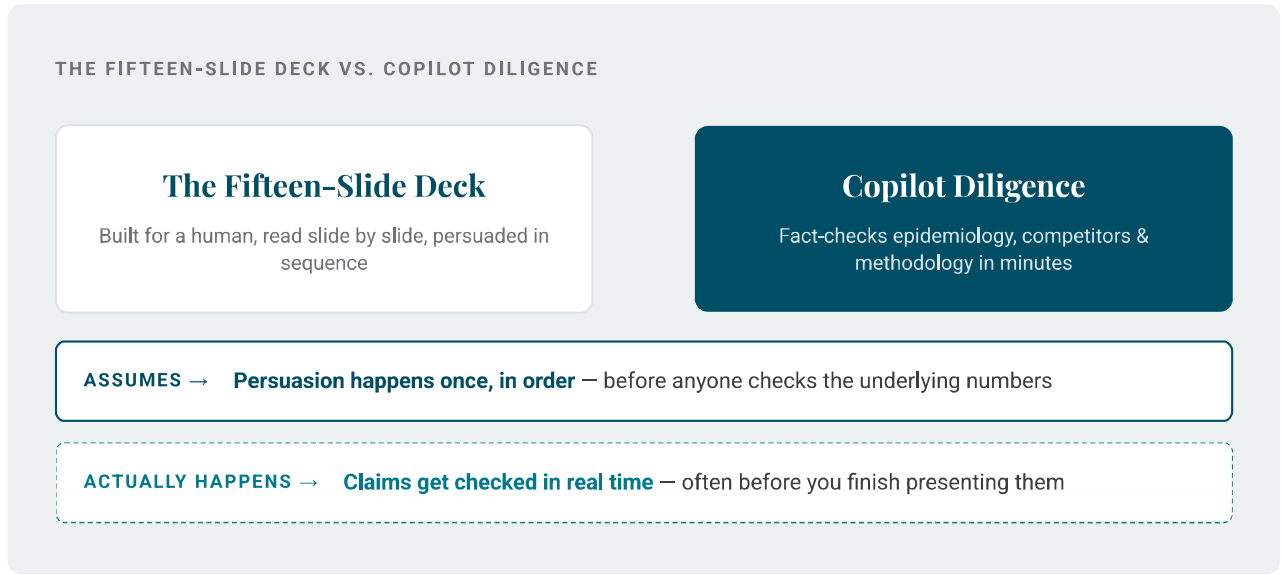
At BIO 2026, two sessions happened on back-to-back days in front of mostly non-overlapping audiences, and together they describe a shift most of the room walked past. On June 24, Donna LaVoie and Elise Simard ran a session on “The LHS Fifteen-Slide Presentation for 2026,” a format built, as it has been for years, around the assumption that a human will read your deck slide by slide and be persuaded in sequence.

A day earlier, on June 23, Ashutosh Joshi, SVP of Commercial Operations at Coherus Oncology, casually described asking Microsoft Copilot for a forecast and watching it check epidemiology databases and run multiple forecasting methodologies in minutes.

“Disease education, epi triangulation, method selection-
work that used to take an analyst days is now more simplified
and available in a few minutes.”

Ashutosh Joshi · SVP, Commercial Operations, Coherus Oncology

Put those two facts side by side and the implication isn’t subtle. You’re still building a fifteen-slide narrative optimized for a human’s attention span and memory, but the person receiving that deck now has a tool that can fact-check your slide six market-sizing claim against an epidemiology database before your slide nine competitive landscape claim even finishes loading. The advice about clarity and story structure isn’t wrong; the deck is obsolete because it was built for an audience that no longer diligences the way it used to.

Founders who treat this as a threat are missing the real opportunity. A deck that survives copilot-
assisted scrutiny is simply a better deck, for human readers too. The discipline required to make a
claim hold up when an Al cross-references it against a public database is the same discipline that
makes a claim persuasive to a sharp human analyst.

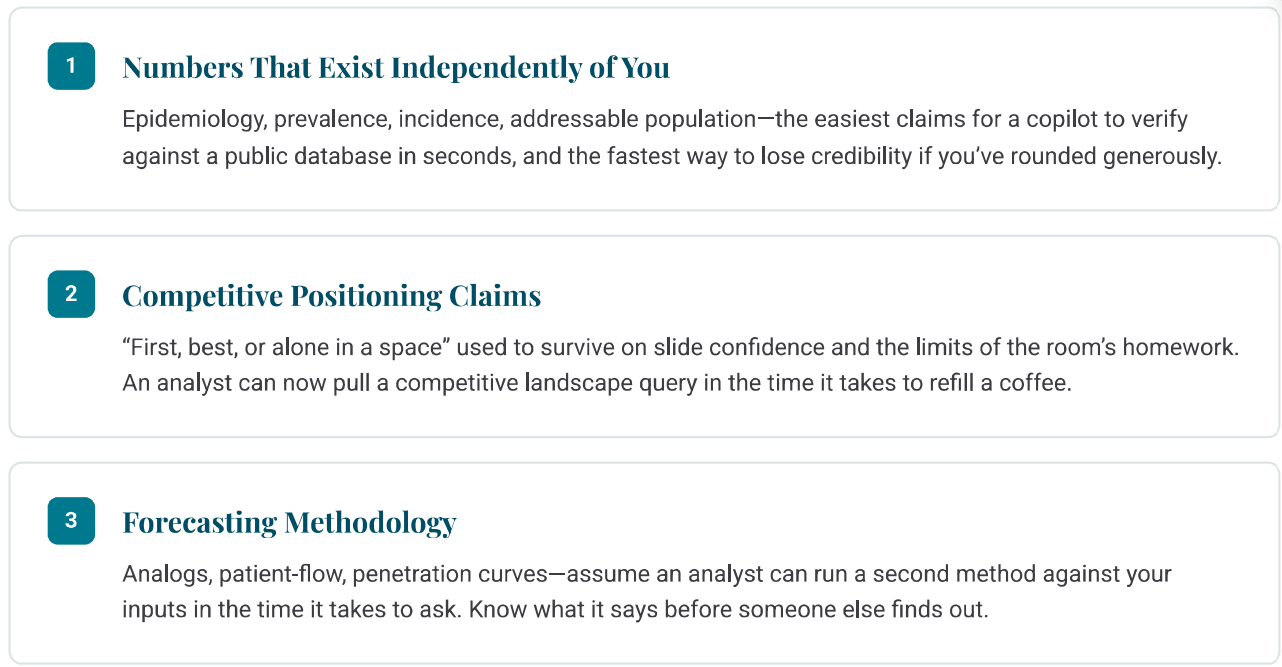
| Which Claims Get Checked First

Not every slide is equally exposed. Three categories get checked before anyone asks a follow-
up question.

None of this means the fifteen-slide discipline LaVoie and Simard teach is wasted effort. Structure
still matters. Story still matters. A human still makes the final call, and a poorly told story will lose to
a well-supported one. But the fifteen slides are no longer the whole diligence process. They’re the
opening argument in a cross-examination that starts the moment you hit send.

Build the deck for the room. But stress-test it for the copilot that’s already reading over the room’s shoulder.

About The Author

At Scimitar, Akira Robinson serves as Partner, Commercialization. He operates at the intersection of commercial strategy, launch execution, and market access, advising biopharma executive teams at critical moments where launch readiness directly determines asset value and time to market. With 20 years of experience across life sciences, diagnostics, biologics, and digital medicine, his work tackles complex commercial challenges for teams across the US and globally. His expertise spans the full commercial value chain—including launch planning, licensing, market access, pricing, analytics, marketing, sales distribution, and patient services across therapy areas, including: oncology, radiopharmaceuticals (RLT), rare disease, CNS, cardiology, and gastroenterology.


Read More​