


loader image

Stop Timing the IPO Window-Build a Company That Doesn’t Need One

The market that made 2021 possible isn’t coming back on your schedule. Plan like it.

| Intended Reader

  • Biotech founders, C-suite executives, and boards planning financing strategy and capital allocation.

| Key Takeaways

  • The Closed Preclinical Window: Market dynamics that enabled easy preclinical public offerings (e.g., 2021) have closed, making timing-based IPO planning unreliable.
  • Prioritize Optionality over IPO-Readiness: Companies should design balance sheets and operational models to support multiple funding routes (e.g., private raises, partnerships, non-dilutive capital) rather than relying solely on public listings.
  • Data-Driven Conviction: Capital allocation should be dictated by internal operational conviction and clear trial targets, rather than macroeconomic speculation on Nasdaq conditions.

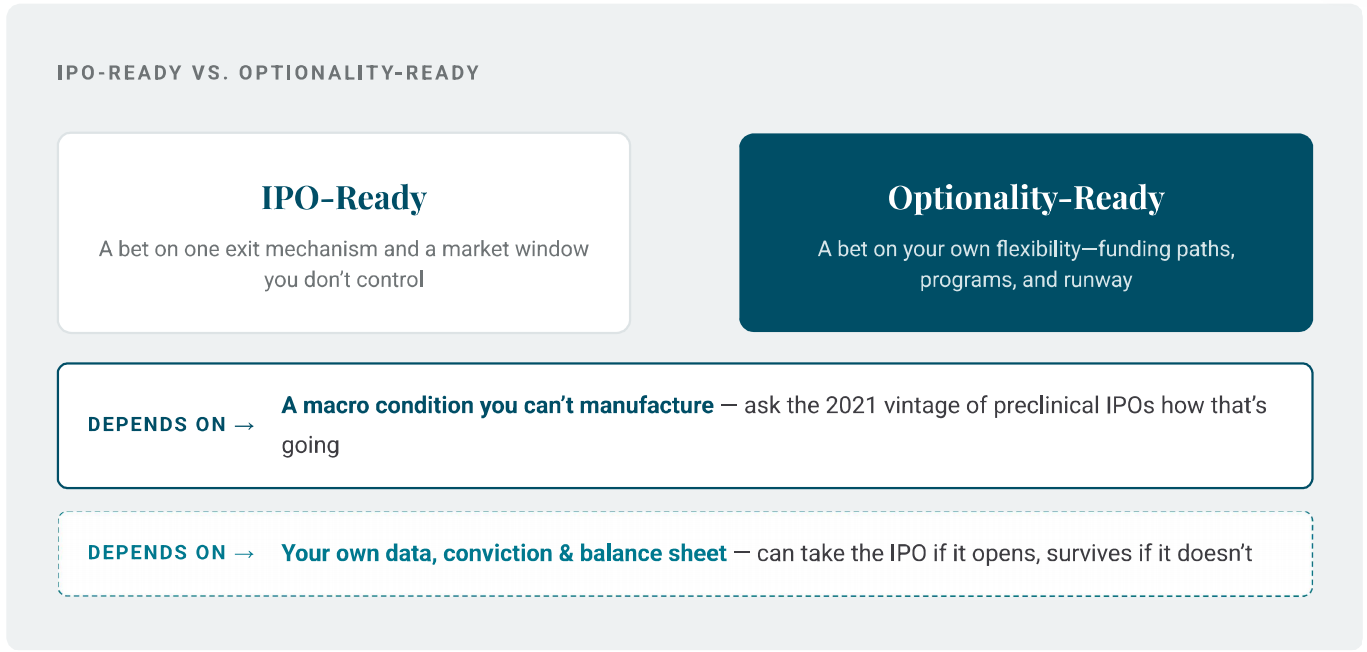
Somewhere in your board deck is a phrase that needs retiring: “IPO-ready.” Readiness still matters, but the word implies a fixed target, a bar that once cleared guarantees a market waiting on the other side. That bar existed. It doesn’t anymore, and founders still planning around its return are making a forecasting error dressed up as a strategy.

| "IPO-Ready" Isn't a Formula

Ben Zeskind, co-founder, president, and CEO of Immuneering, put it plainly on a BIO 2026 panel: Immuneering IPO’d in 2021 as a preclinical company, and that isn’t happening now. Zeskind isn’t being pessimistic here; he’s pricing his own past success correctly, as the product of a market window that has closed, not a repeatable formula.

“Immuneering IPO’d in 2021 as a preclinical company, and
that isn’t happening now. Not harder. Not happening.”

Ben Zeskind . Co-Founder, President & CEO, Immuneering

That distinction matters, because a lot of biotech board conversations are still structured around chasing the conditions of 2021. Boards ask when the IPO window will reopen, as if it’s a weather pattern to wait out, instead of asking the harder question: what does this company need to be true regardless of when, or whether, that window reopens?

| Assess the Environment You Actually Have

Danielle Appelhans, president and CEO of COUR Pharmaceuticals, framed the honest version of that question at the same event. Macro conditions and company-specific timing both matter: the IPO market has slowed, and companies need to assess candidly where they stand and how to raise money given the environment that actually exists, not the one they’d prefer.

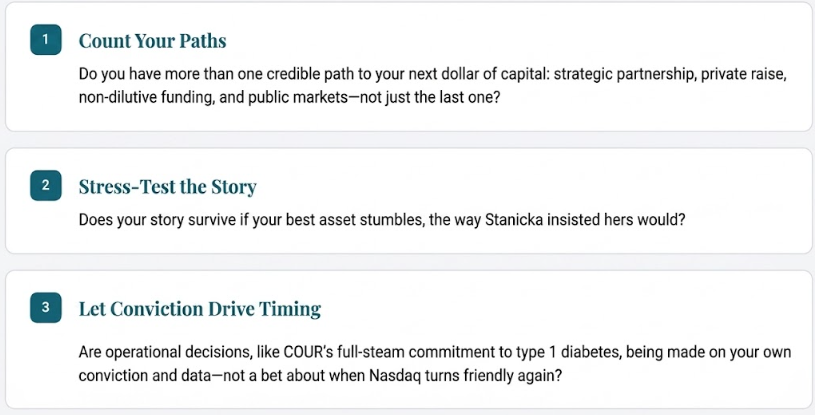
COUR’s answer wasn’t to wait for a friendlier IPO market. It was to go full steam on type 1 diabetes, committing resources to the program with the clearest path and letting the financing strategy follow operational conviction instead of macro speculation.

| Build for Optionality, Not a Listing Date

Joanna Stanicka’s experience at Axonis is the sharpest version of this lesson, because she had the IPO path available and chose not to structure the company around it. Bankers were interested; they wanted to build a public offering narrative around Axonis. For most founders, that’s the dream conversation: bankers pursuing you. Stanicka didn’t take the bait.

Her priority was optionality: multiple funding paths, the ability to advance more than one program at once, and enough flexibility that no single outcome, including an IPO on someone else’s timeline, determined the company’s fate. She got direct feedback from investors and bankers that a single-asset story wouldn’t be enough to sustain an IPO path. Rather than treat that as a problem to spin, she treated it as accurate information about what her company needed and built toward optionality instead of a listing date.

Stop asking whether you’re IPO-ready. Start asking whether
you’re optionality-ready.

The reframe every board should adopt

| What Boards Should Judge Instead

This isn’t an argument against ever going public. It’s an argument against building a company whose only good outcome runs through a market condition you can’t manufacture. Three questions replace the window-timing debate:

The IPO window will reopen eventually; nobody credible claims otherwise. But a company that spends the interim building optionality will be ready to use that window when it appears, and won’t be left exposed and out of runway if it doesn’t.

About The Author

At Scimitar, Akira Robinson serves as Partner, Commercialization. He operates at the intersection of commercial strategy, launch execution, and market access, advising biopharma executive teams at critical moments where launch readiness directly determines asset value and time to market. With 20 years of experience across life sciences, diagnostics, biologics, and digital medicine, his work tackles complex commercial challenges for teams across the US and globally. His expertise spans the full commercial value chain—including launch planning, licensing, market access, pricing, analytics, marketing, sales distribution, and patient services across therapy areas, including: oncology, radiopharmaceuticals (RLT), rare disease, CNS, cardiology, and gastroenterology.


Read More​