
Making room for what matters when AI begins to help with the work.
| Intended Reader
- Professionals and leaders who want to use recovered time for meaningful work and personal priorities.
| Key Takeaways
- Identify what you want more time for and why it matters to you.
- Reorganize your day to include briefing, review, and the priorities you want to protect.
- Leaders need to clarify priorities and help people decide what they can put down.
If you recovered an hour this week, what would you want to do with it?
You may already have an answer. There is probably something you’ve been putting off because you haven’t had the time. It could be a conversation, a piece of thinking, or an afternoon when you finish work with enough energy left for the people at home.
It could also be rest.
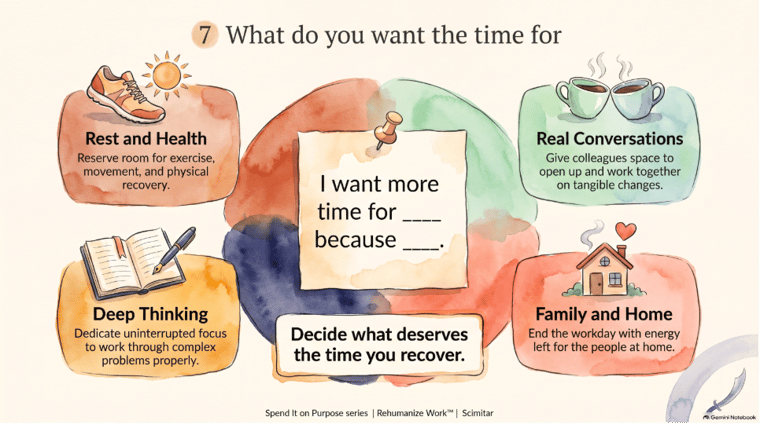
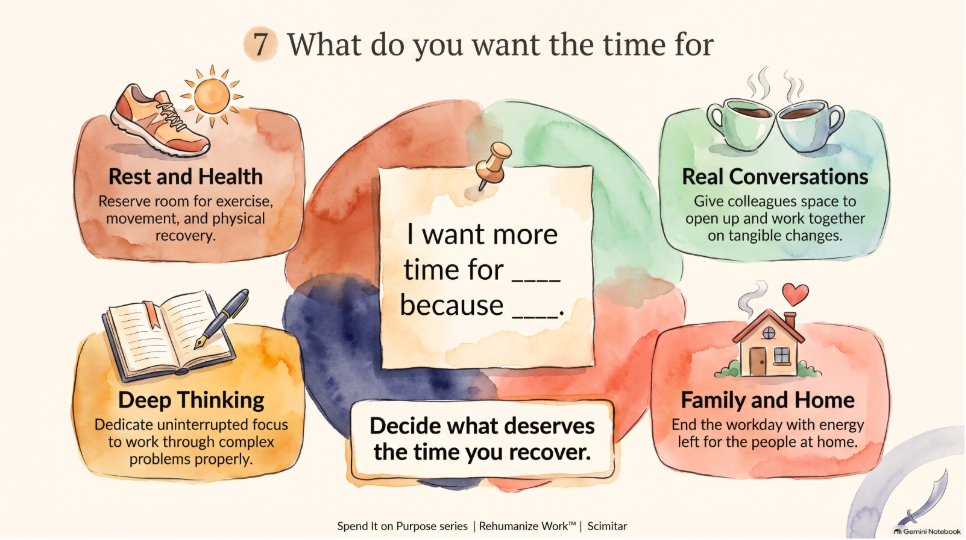
For me, I want more room for rest and exercise. In my work, I want time for real conversations with people. I want to give them space to open up about how they’re feeling and work together on tangible changes that help them feel more at peace, a little happier, and able to do more of what they love.
Those are some of the reasons I’m willing to invest effort in changing how I work with AI. They help me decide where that effort is worth spending.
Remember what you want the time for
In the first article in this series, I described starting with a recurring irritation. Something you do every day or every week that gets in the way. For me, one example was the collection of tasks that comes with work travel.
It’s useful to address those things. It’s also worth asking what you want to make possible by doing so.
When you think about your own why, consider what originally pulled you toward your work. What did you want to contribute? What part of the work still matters to you? What deserves more attention in the chapter you’re in now?
You don’t need a polished purpose statement to answer. You might simply want more time to work through a problem properly. Perhaps you want to be available when a colleague needs to talk, rather than trying to squeeze the conversation between meetings.
Your personal life belongs in this question as well. If your day routinely leaves you too tired to exercise or too distracted to enjoy time with your family, that is worth considering as you reorganize your work.
Write one sentence: “I want more time for ___ because ___.” Give yourself an honest answer, even if it sounds ordinary.
Reorganize the day as the work changes
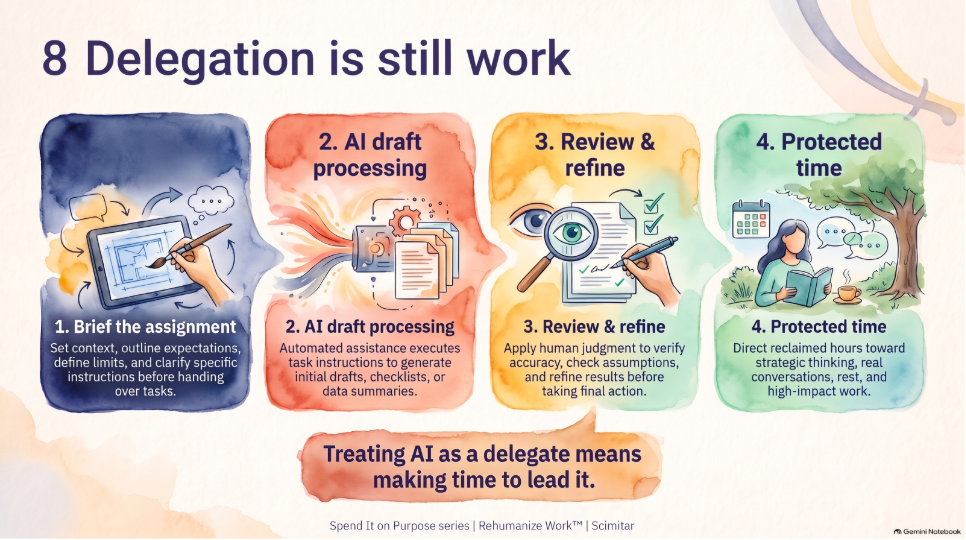
Learning to use AI takes time. You have to explain the assignment, provide context, and review the result. You may need several attempts before you have a useful way of working together.
As that develops, your day needs to change with it.
If AI helps prepare a draft, when will you brief it and when will you review the work? What information needs to be ready beforehand? Which parts still require your judgment?
These questions matter because delegation is still work. Treating AI as a delegate or virtual employee means making time to lead it. You need a place in the day for that responsibility.
If you need help defining the assignment and your own role in it, How Clearly Are You Asking? offers a practical place to start.
You also need to notice when a task has become easier. Otherwise, you can keep organizing your calendar around the old way of doing it. A block remains longer than it needs to be, or you spend the recovered time checking and rechecking a result without deciding what a sufficient review requires.
Try observing one task over a week. Notice the preparation, the time spent doing it, and the review. Then decide what you would change the next time. You may need a shorter block, a different sequence, or clearer instructions before you see a benefit.
Leaders have a responsibility here
People can make useful changes within their own work. Leaders also have a responsibility to provide direction they can anchor to.
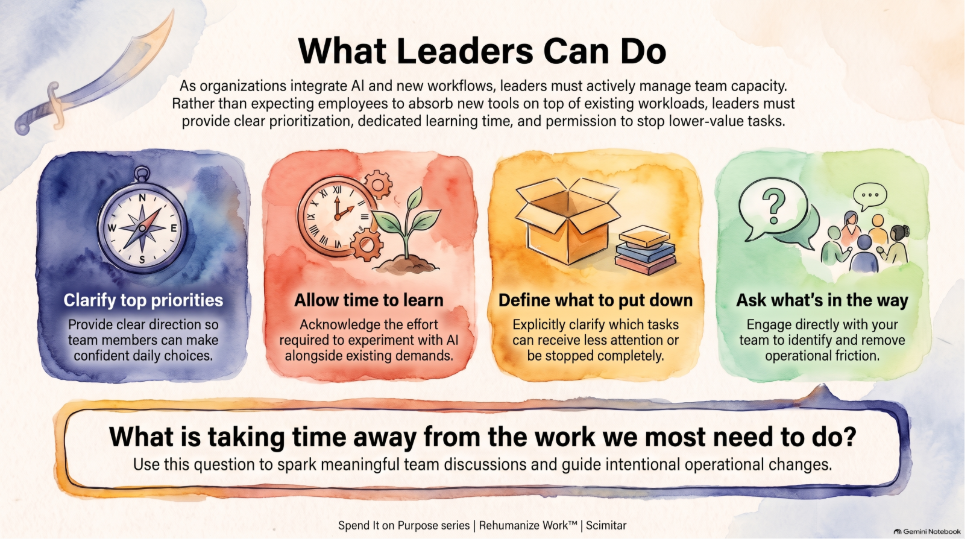
If you’re asking your team to learn AI while every existing demand stays in place, you need to address the time that learning requires. What can receive less attention while people experiment? Where can someone ask for help? What would be a useful first application for the team?
Be specific about what you hope the change will make possible. If you want people to spend more time with customers, explain which work can be reduced to make room. If you want stronger recommendations, allow time to think through the information rather than expecting a faster draft to be a finished decision.
People should be able to understand the priorities well enough to make choices during an ordinary workday. They also need to know what they can put down.
As a leader, ask yourself what you will change, too. You may need to stop requesting an update that no longer serves a purpose, provide clearer assignments, or make a decision that has left people waiting.
A useful conversation with your team could begin: “What is taking time away from the work we most need to do, and what can I help change?” Be prepared to act on what you hear.
Protect a small amount of time
Start with one part of the week you can influence.
Choose something you want more room for and give it a place on your calendar. Be specific enough that you will know whether you did it. You might reserve thirty minutes to think through a recommendation before drafting it, arrange a conversation you’ve postponed, or finish at a time that lets you take a walk.
If the choice requires agreement from your manager or team, have that conversation. Some constraints need a shared decision. You don’t have to treat all of them as something you should solve alone.
At the end of the week, look back. Did you use the time as you intended? If something else took over, what happened? Was the priority unclear, did an urgent need arise, or did you fall into a familiar habit?
Use the answer to adjust next week. The point is to practice making a choice and following through, with enough flexibility to respond to real life.
My aim in this work has always been to partner with people to reshape their days, teams, and organizations so they can do more of what they love, while I get to do what I love.
That is what “spend it on purpose” means to me. When something in your work becomes easier, pause long enough to consider what deserves the time you recover.
What would you like to make room for this week?
Read the other papers
Start with the Paper Cut. Find a manageable place to begin by addressing one recurring irritation.
How Clearly Are You Asking?. Give your delegate enough context and clarity to help with the work.
About Christina and Rehumanize Work™
Christina Levine is a Partner at Scimitar and the founder of Rehumanize Work™. With nearly twenty years of experience in consulting, strategic business management, and leadership development, she helps people reshape their days, teams, and organizations so they can do more of what they love. Her work brings Purpose, Presence, and Process into everyday practice through coaching, workshops, and practical changes to how work gets done.
If you or your team could use a partner in figuring out where to begin, reach out through scimitar.com. I’d welcome a conversation about what’s getting in your way and what we could work on together.
Related Topics