
| Intended Reader
- Heads of R&D, portfolio management and clinical operations leaders
| Key Takeaways
- Programs sit idle between studies for a median of almost two years, 41% of the time from first-in-human to the pivotal trial.
- The gap isn't trial start-up; it's data analysis, the go decision and writing the next protocol.
- Closing the gaps to top-quartile levels would get medicines to patients about 9 months sooner without shortening a single trial.
Between studies, drug programs sit still for a median of almost two years. No trial is running, and no patient is getting any closer to the medicine.
Last week we showed that it takes almost nine years to get a new medicine from the first patient dosed to FDA approval, and that the fastest quarter of programs reach patients about two years sooner. This week we look at the single biggest place that time goes. It isn’t inside a trial. It’s between them.
What white space is
White space is the time from the end of one study to the first patient dosed in the next. During it, the program is analyzing data, deciding whether to go on, meeting with FDA, writing the next protocol and preparing to start. All of that matters. But no trial is running, and for the patients waiting on the medicine, nothing is moving.
We measured it in every FDA novel approval since 2020, wherever a program ran its studies back to back:
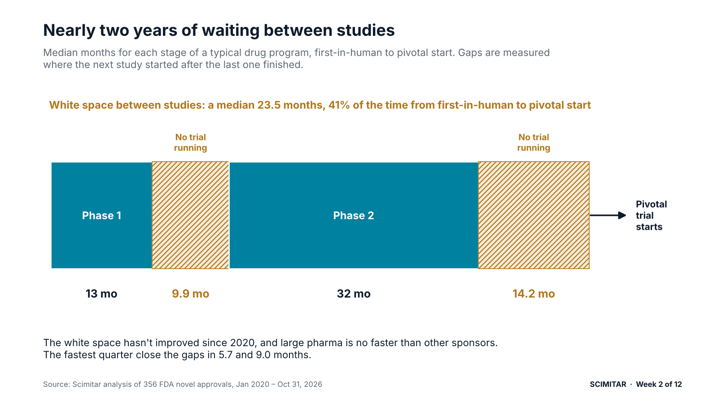
- Phase 1 to Phase 2: a median of 9.9 months with no trial running.
- Phase 2 to the pivotal trial: a median of 14.2 months.
- Both gaps together: a median of 23.5 months, or 41% of the time from first-in-human to the start of the pivotal trial.
The gaps aren’t harmless pauses. Programs with longer gaps take significantly longer to reach approval overall.
It hasn’t improved, and size doesn’t help
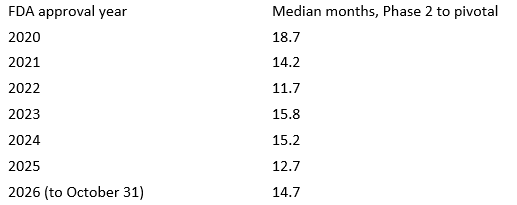
There is no trend across these years. Large pharma, with more people and more resources, is no faster: its gaps (10.4 and 11.7 months) are not significantly different from other sponsors’. This is an industry-wide habit, not a resource problem.
It isn’t trial start-up
It’s tempting to blame the gap on getting the next trial running: contracts, sites, approvals. The data says otherwise. Once a pivotal trial is registered, the first patient is dosed a median of 1.7 months later. The lost time comes earlier, in the months between the data arriving and the next study being ready to register: analysis, the go decision, regulatory discussion and protocol writing.
The fastest programs close the gap
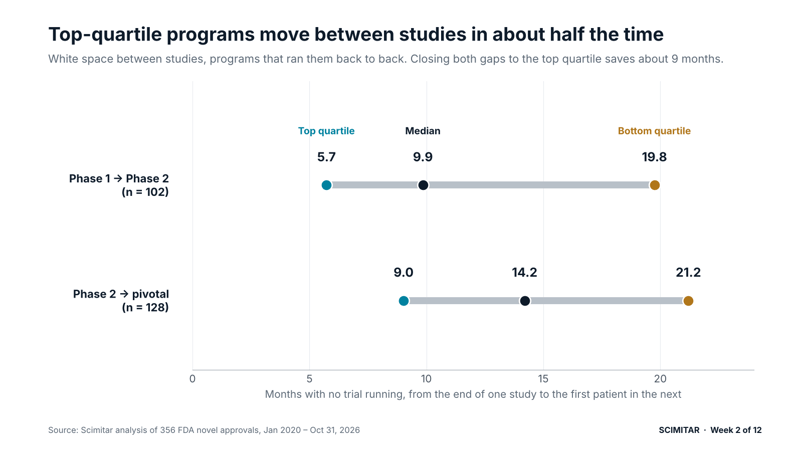
The fastest quarter of programs move from Phase 1 to Phase 2 in 5.7 months or less, and from Phase 2 to pivotal in 9.0 months or less. Bringing both gaps from the median to the top quartile saves about 9 months. A program in the slowest quarter loses about 17 months more.
Nine months sooner for patients, without shortening a single trial, cutting a single patient or changing a single endpoint. The rigor of the studies stays exactly the same. Only the waiting changes.
What fast programs do differently
From what we see working with sponsors, the programs that move quickly between studies tend to:
- Plan the next study before the data arrives. Protocol drafts, site and vendor choices and regulatory meeting requests are ready to go, so a positive result triggers action rather than a planning cycle.
- Agree the go/no-go criteria in advance. When the decision rules are set before unblinding, the decision takes weeks, not months.
- Overlap where the risk allows. Some programs start the next study before the last one ends, or combine phases into one trial. Next week we show how much time that saves.
- Give someone ownership of the gap. Trials have owners, timelines and budgets. The time between them often belongs to no one.
Questions to ask about your own programs
- How long did your last programs spend between studies, and does anyone track it?
- When your last Phase 2 read out, was the pivotal protocol already drafted?
- Were your go/no-go criteria agreed before the data arrived?
- Who in your organization owns the time between studies?
- What would nine months sooner mean for the patients waiting for your lead program?
What’s next in the series
Next week: sequential is slow. Programs that overlap Phase 2 and pivotal planning reach the pivotal trial about 20 months sooner, and we look at when that makes sense.
How Scimitar helps
Closing these gaps is rarely about working faster. It’s about deciding faster: having the go decision, protocol and start-up planned before the data arrives. That’s the work Scimitar does with sponsors, so medicines reach patients sooner.
For 20 years, Scimitar has helped sponsors get medicines to patients faster, from first-in-human through submission, with the quality and rigor patients deserve. This benchmark of every FDA novel approval since 2020 draws on that experience. If you’d like to see where your program sits against the benchmark, start a conversation with our team.
About the data: Scimitar benchmark of 356 FDA novel approvals, January 2020 to October 31, 2026. White space runs from the primary completion of one phase (the last patient’s primary-endpoint data) to the first patient dosed in the next. Phase 1 to Phase 2 uses the first Phase 2 in any indication; Phase 2 to pivotal uses the key Phase 2 in the approved indication and the first pivotal trial. Programs that overlapped phases or combined them into one trial have no gap to measure and are counted separately. Sources: ClinicalTrials.gov and other trial registries, company disclosures, FDA approval letters and review documents.
Give Us A Call
Our team of experienced life-science consultants collaborate with your team, from strategy development through implementation. By combining experience and innovation, Scimitar works with you to achieve proven results.
Contact Us
Related Topics