

| Intended Reader
For biopharma CEOs, Chief Digital Officers, Chief Operating Officers, and other C-suite executives who have recognized that AI ambition alone is not sufficient and are now asking how to build the operating model, governance structure, and portfolio discipline required to convert AI investment into compounding enterprise value.
| Key Takeaways
AI programs scale when managed as a system, not a collection of initiatives.
- A portfolio approach treats AI as a managed enterprise asset, linking strategy to a funded pipeline, delivery to repeatable execution, and deployment to sustained adoption.
- The result is a compounding flywheel: each successful deployment improves the economics of the next, shortening time to production, lowering marginal delivery cost, and increasing the probability of sustained, measurable impact.
The single most consequential governance decision in any AI program is archetype classification.
- Biopharma AI initiatives fall into two distinct archetypes, Sustaining and Disruptive, each requiring fundamentally different governance, funding mechanisms, success metrics, and change management approaches.
- Governance mismatches are not cultural failures; they are structural ones. Applying sustaining governance to a disruptive initiative terminates it prematurely. Applying disruptive governance to a sustaining initiative produces accountability gaps that erode confidence and investment across the entire portfolio.
Portfolio allocation is a strategic choice driven by four key variables.
- The right balance between sustaining and disruptive AI initiatives is shaped by corporate strategy and pipeline portfolio, organizational binding constraints and AI maturity, financial health and risk appetite, and the competitive landscape and AI market timing.
- Organizations facing near-term loss of exclusivity require a heavier sustaining orientation. Those pursuing differentiation-driven platform strategies may justify a more disruptive posture.
The compound advantage is available for the taking, but only to organizations that make three structural decisions before they deploy.
- The biopharma organizations that will outperform the market in AI over the next five years will not be those that launched the most AI pilots.
- They will be those that (a) established governance with real decision rights over prioritization, funding, and risk appetite, (b) built the data, platform, and engineering foundation to support both sustaining and disruptive initiatives, and (c) assessed end-to-end workflows before implementing AI.
Part 2 of 2 in the Series: “Operating AI as a Portfolio in Biopharma”
Part 1 of this series diagnosed why AI fails to scale in biopharma, highlighting three mutually reinforcing breaking points rooted not in technology, but in portfolio, operating model, and adoption failure. In Part 2, we shift from diagnosis to prescription: what does a portfolio model look like in practice? How should executives choose the right position for their organization? Most importantly, what must be in place to ensure value compounds over time?
The AI Value Operating Flywheel
The core philosophy is simple: AI programs stall when managed as a collection of initiatives. They scale when managed as a system. A portfolio approach treats AI as a managed enterprise asset, linking strategy to a funded pipeline, delivery to repeatable execution, and deployment to sustained adoption. The result is a compounding flywheel: each successful deployment improves the economics of the next, shortening time to production, lowering marginal delivery cost, and increasing the probability of sustained, measurable impact.
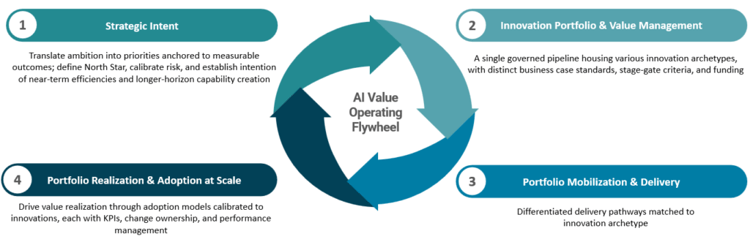
Scimitar’s AI Value Operating Flywheel approach operationalizes this model across four interlocking phases, illustrated in Figure 1:
Figure 1: Scimitar’s AI Value Operating Flywheel
Phase 1 | Strategic Intent
The flywheel begins by translating AI ambition into enterprise priorities anchored to biopharma’s binding constraints: cycle time, throughput, and cost per outcome. The C-suite defines an explicit AI North Star with measurable business outcomes and a clear risk appetite. This includes an explicit, directional commitment on the intended balance between near-term operational efficiency gains and longer-horizon capability creation from AI.
Phase 2 | Innovation Portfolio and Value Management
Strategic intent becomes a single, governed pipeline of AI initiatives, aligned to business case standards, stage-gate criteria, and explicit value accountability. This replaces the pilot proliferation that characterizes most AI programs with a managed, funded portfolio with clear accountability.
Phase 3 | Portfolio Mobilization and Delivery
Initiatives move through differentiated delivery pathways matched to their innovation archetype, with shared infrastructure for data readiness, model validation, GxP compliance, and system integration providing a common execution foundation. Reuse of proven components and shared validation patterns allows each initiative to be delivered faster and cheaper.
Phase 4 | Portfolio Realization and Adoption at Scale
Deployment is the midpoint, not the endpoint. AI is integrated into daily workflows and decision rights through adoption models calibrated to each respective initiative. Each requires named change ownership, appropriate KPIs, and performance management designed for its distinctive value creation mechanism.
Two Archetypes, One Discipline: The Governance Decision That Determines Portfolio ROI
Before allocating a single dollar of AI investment, the C-suite must make one foundational decision: what kind of AI innovation to fund, and in what proportion. This is the critical objective of Phase 1 in the AI Value Operating Flywheel.
Biopharma AI initiatives fall into two distinct archetypes, each creating value through different mechanisms, time horizons, and governance requirements. Specific details can be found in Figure 2 and the subsequent descriptions:
Figure 2: AI Innovation Archetypes
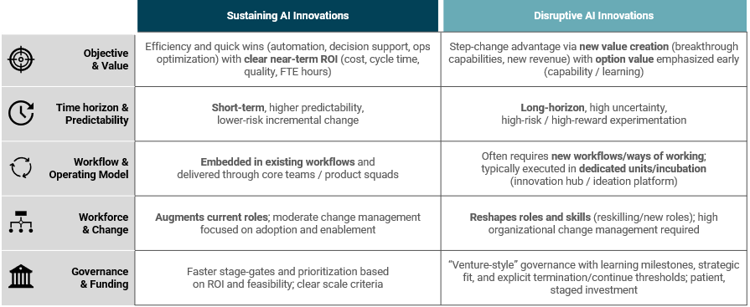
Sustaining AI innovations target workflow productivity, quality, and cycle time within the existing operating model. They integrate into current processes and systems, augmenting roles by shifting work away from repetitive execution toward higher-value judgment. Because they tie directly to measurable operational outcomes, sustaining initiatives are amenable to traditional ROI measurement and can scale at an accelerated rate. This is the primary lever for compressing time-to-value, increasing throughput per FTE, and structurally reducing cost inputs — delivering returns inside the patent window where they matter most.
Disruptive AI innovations pursue fundamentally new capabilities, operating models, or data monetization opportunities that reshape competitive positioning. They operate over longer time horizons, carry greater uncertainty, and require the formation of new workflows and roles. New value creation may include breakthrough capabilities, step-change competitive positioning, and new sources of revenue. Early value can be appropriately captured through strategic learning and option value (e.g., validated technical feasibility, pilot performance thresholds, and a clear path to scale) before financial ROI becomes the primary lens.
The critical nuance: Applying sustaining governance to a disruptive initiative will terminate it prematurely. Applying disruptive governance to a sustaining initiative produces accountability gaps that erode confidence and investment.
The reason governance mismatches lead to value destruction is structural, not cultural. Sustaining initiatives have clear operational owners, measurable baselines, and existing workflows to integrate into, with governance designed for accountability and speed to produce the right outcomes. Disruptive initiatives have none of these. Their value is probabilistic, their timelines are non-linear, and their early indicators of success are more about learning and less about financial return in the early stages. When a C-suite applies sustaining governance to a disruptive initiative, demanding ROI timelines and accountability structures that the initiative cannot yet meet, this does not demonstrate discipline. It is applying the wrong instrument to the wrong problem — the initiative either gets terminated before it can demonstrate its value or gets reshaped into something closer to a sustaining innovation to survive budget cycles. Similarly, the inverse of this failure can also be detrimental to organizations; sustaining initiatives managed with disruptive patience and flexibility in stage-gate criteria produce accountability gaps, stalled adoption, and eroded confidence that ripples back to the entire portfolio. The portfolio model’s core purpose is to make this distinction explicit before governance design begins — not after the initiative is already in motion.
The Allocation Decision: Four Variables That Define Your Portfolio Position
Determining the appropriate mix of sustaining and disruptive AI initiatives is a strategic choice for the enterprise. Four organizational variables have been seen to drive the allocation:
- Corporate Strategy and Pipeline Portfolio: Organizations facing near-term loss of exclusivity on a large, branded footprint likely require a heavier proportion of sustaining AI innovations to protect near-term cash flows and throughput. Organizations pursuing a concentrated therapeutic area platform or differentiation-driven strategy may justify a more disruptive orientation, provided leadership remains disciplined about when and how those bets translate into scalable value.
- Binding Constraints: Portfolio allocation must match what the organization can execute and absorb. Organizational AI maturity compounds this constraint: an organization with limited technical capability-building may consider emphasizing mobilization of sustaining initiatives until the foundational infrastructure can support the higher uncertainty of disruptive bets.
- Financial Health and Risk Appetite: When margins are under pressure or capital is constrained, sustaining initiatives that deliver near-term cycle time compression and cost-per-outcome reductions become the more attractive portfolio bet. As financial flexibility increases, shift deliberately toward disruptive options, funded through stage-gated mechanisms with clear termination thresholds.
- Competitive Landscape and AI Market Timing: Although the first three variables above are internally focused, the external environment warrants equal weight. For example, if a primary therapeutic area competitor has already deployed scaled AI infrastructure or acquired AI-native capabilities, the risk appetite for your AI portfolio is likely to shift, regardless of internal readiness.
The Execution Foundation
Regardless of your approach, it is critical to make explicit portfolio choices, aligning the proper governance and success metrics to the relevant innovation archetype, and continue to assess and redistribute focus as pipeline dynamics, capital constraints, and market conditions evolve. Determining your portfolio position is only the start. Successful execution requires foundational capabilities focused on addressing the Breaking Points identified in Part 1 of this series:
- Strategy, governance, and value management: Standardized business cases, explicit accountability, stage-gated funding, and benefits tracking tied to corporate priorities
- Data, platform, and engineering foundation: Enterprise-grade data products, interoperability standards, shared validation infrastructure, and modular architecture for both sustaining and disruptive initiatives
- Product integration, talent, and ecosystem enablement: AI embedded in core systems, workflows designed around the technology, and users trained and incentivized to adopt at scale
The Compound Advantage Is Available—But It Must Be Built
The biopharma organizations that will outperform the market over the next five years will not be those that launched the most AI pilots. They will be those that operated AI as a managed portfolio, converting investments into faster time-to-market, higher throughput, lower cost per successful outcome, and greater resilience as external pressures intensify.
What separates these organizations is not that they moved faster or spent more. It is that they made certain structural decisions before they deployed. They established governance with real decision rights, including clear authority over prioritization, funding, risk appetite, and when to scale or stop, rather than leaving those questions to emerge initiative by initiative. Most importantly, they assessed end-to-end workflows before selecting technology, ensuring that AI was deployed into processes designed to leverage it, not layered onto workflows that needed fundamental redesign first.
The AI Value Operating Flywheel is not self-starting. It requires explicit strategic choices, the governance to enforce them, and the capability infrastructure to make each rotation faster and more economical than the last.
If your organization is evaluating how to close the gap between AI ambition and measurable enterprise value, that is precisely where the work begins.
This is Part 2 of 2 in the series “Operating AI as a Portfolio in Biopharma.” Part 1, “Why AI Fails to Scale in Biopharma: 3 Breaking Points for the C-Suite”, can be found HERE.
References
March, J.G. "Exploration and exploitation in organizational learning." Organization Science, 1991. https://www.jstor.org/stable/2634940
O'Reilly, C.A. and Tushman, M.L. "The Ambidextrous Organization." Harvard Business Review, April 2004. https://hbr.org/2004/04/the-ambidextrous-organization
Give Us A Call
Our team of experienced life-science consultants collaborate with your team, from strategy development through implementation. By combining experience and innovation, Scimitar works with you to achieve proven results.
Contact Us
Related Topics