

| Intended Reader
For biopharma CEOs, CFOs, Chief Digital Officers, and Chief Operating Officers evaluating why their AI investments are not yet generating enterprise-scale returns and what it will take to change that.
| Key Takeaways
- The AI value gap in biopharma is not a technology problem: it is a leadership and operating one. More than two-thirds of organizations have not yet begun scaling AI across the enterprise, despite significant investment. The constraint is how AI is governed, prioritized, and embedded into workflows, not the capability of the models themselves.
- Three mutually reinforcing breaking points explain why AI fails to scale: 1. Ambition without workflow discipline stalls strategy. 2. Premature vendor and solution decisions create integration debt and speed without sustainability. 3. Deployed AI that goes underutilized destroys the compounding returns that make AI a genuine business lever. Each failure mode is amplified by the others, locking organizations in a cycle that pilot launches alone cannot break.
- The solution is a portfolio approach that treats AI like a managed enterprise system. A portfolio model forces three practical shifts in focus: from use cases to enterprise friction, from pilots to a governed pipeline, and from deployment to adoption at scale. Each shift directly addresses one of the three breaking points; together, they create a compounding flywheel where each successful deployment improves the economics of the next.
- Three diagnostic questions every C-suite team should be able to answer before authorizing the next AI pilot: Are we targeting the right operational friction? Can we scale safely without integration debt? And have we engineered for sustained adoption, or are we measuring success at the point of deployment and hoping behavior follows?
Part 1 of 2 in the Series, “Operating AI as a Portfolio in Biopharma”
Introduction
Biopharma is not short on AI ambition. What’s scarce is time-to-value.
The industry is increasingly governed by three hard constraints: time (the patent clock), productivity (many failures before success), and economics (the cost required to produce a successful outcome). Add in loss of exclusivity, higher evidence expectations, persistent cycle-time bottlenecks, and tighter capital, and the C-Suite mandate becomes unavoidable: compress timelines, increase throughput, and reduce cost per outcome.
AI should be a powerful lever against these constraints. It can automate and accelerate work, improve decision quality, reduce rework, and increase the marginal productivity of scarce, expert talent. Yet the enterprise value isn’t showing up at scale: global surveys indicate more than two-thirds of organizations have not yet begun scaling AI across the enterprise.
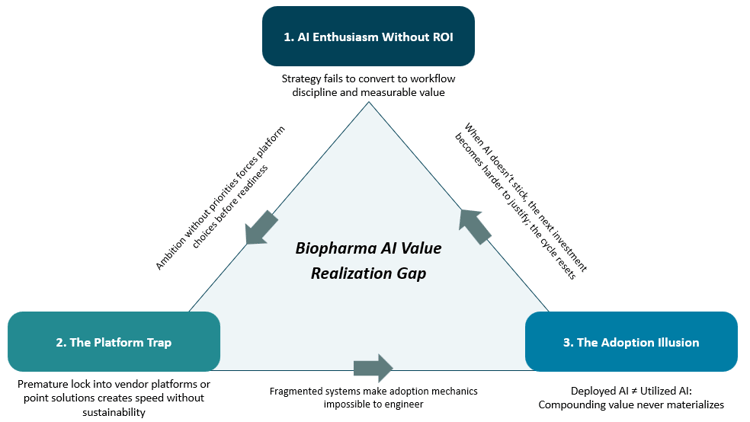
This is not a technology problem. It is a leadership and operating problem. Across biopharma, three recurring “breaking points” consistently stall outcomes, directly undermining speed, productivity, and economics. These points are illustrated in Figure 1 and the supporting detailed points below:
Figure 1: The Biopharma AI Breaking Points Model
Point #1 | From AI Enthusiasm to ROI: Why Biopharma Programs Stall at the Strategy Layer
Most AI programs start with enthusiasm (“AI-first,” “GenAI copilots,” “automation at scale”), but face challenges in translating that ambition into an explicit set of workflow priorities tied to the constraints faced in the biopharma industry. Accountability for value is often unclear, benefits tracking is inconsistent, and the predictable result is a large volume of pilots with slow scale-up and limited compounding ROI.
In practice, this may look like the following:
- A long list of use cases, but no shared view of the 3–5 workflows that are critical in driving accelerated time-to-value.
- Time saved at the individual level does not convert into reduced end-to-end cycle time.
- Solutions get deployed, but don’t become the default way work gets done.
When strategy isn’t converting into full, tangible value creation, AI is seen as an activity rather than a growth driver to improve P&Ls.
Point #2 | The Platform Trap: How Premature Decisions Stall Biopharma at Scale
In the push for speed, organizations often lock into vendor platforms or point solutions too early, creating integration debt, limiting flexibility, or failing to meet evolving expectations for regulated workflows. Leaders find themselves caught between conflicting objectives: move fast, but also protect security, compliance, auditability, and optionality as the landscape evolves.
The trap is that platform risk rarely shows up in a pilot, but presents itself at scale, resulting in:
- A wide range of solutions with inconsistent standards, producing increased rework.
- Data and workflow fragmentation that prevents repeatable delivery of AI solutions.
- Late-stage compliance surprises that delay production and scale-up.
Moving fast becomes a fragile, high-risk experience, and the organization is unable to create production-grade AI solutions at the speed required to be competitive.
Point #3 | The Adoption Illusion: Why Deployed AI is Not the Same as Utilized AI
Even with a clear strategy and the appropriate solutions, AI does not scale without biopharma-fluent talent and adoption mechanics.
Across organizations, there is typically a scarce presence of biopharma-domain AI expertise and insufficient workflow integration support, leading to stalled adoption. Many programs measure success as deployed AI rather than sustained utilization, performance, and behavioral change. The consequences are low utilization, shadow processes, and minimal impact on the constraints that matter at the enterprise level.
This is the most expensive failure mode because it destroys opportunity for compounded value. Specific outcomes may include the following:
- Adoption is low, leading to sporadic periods of value; this results in lower confidence from executives, leading to inconsistent investments and discipline toward AI.
- Capacity expands, but not effectively redeployed to create stepwise productivity gains.
- Decision quality locally improves, but decision cycles don’t compress at an enterprise level.
If adoption is not engineered into workflows, incentives, and performance management, AI will remain a series of pilots, no matter how impressive the model is.
C-Suite Implications: The Shift to a Portfolio Model
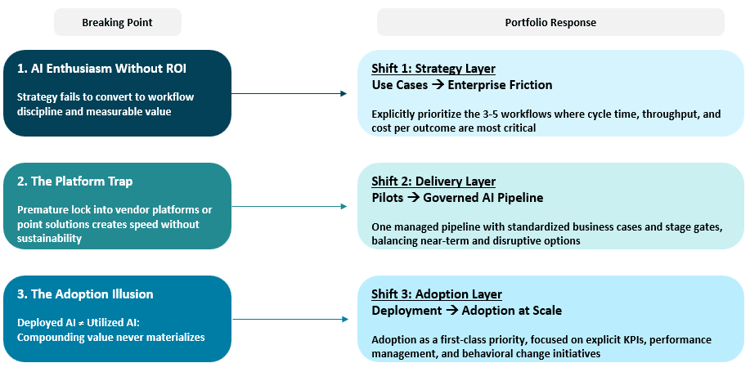
The recurring breakpoints above are not rooted in AI capability. They are rooted in portfolio, operations, and adoption mechanics. A portfolio approach works because it treats AI like a managed enterprise system, linking strategy to a funded pipeline, delivery to repeatable execution, and deployment to sustainable adoption using governance and metrics that are relevant to the C-Suite. The result is a flywheel effect: each successful deployment improves the economics of the next, shortening time to production, lowering marginal delivery cost, and increasing the probability of sustained value. This portfolio response is illustrated in Figure 2 below:
Figure 2: The Portfolio Response | Three Shifts to Scale AI
Three Questions Executives Can Use to Pressure-Test their AI Strategy
To escape the AI biopharma breaking points and build a successful AI portfolio that compounds value at scale, executives must honestly evaluate their operational readiness. Before authorizing another pilot, ask your team:
- Are we targeting the right friction? Where is the enterprise most constrained by time and economics, and which 3-5 specific workflows must we explicitly prioritize to accelerate our time-to-value?
- Can we safely scale without integration debt? What structural and governance models must be in place to develop and deliver a repeatable, production-grade AI pipeline?
- Are we engineering for sustained adoption? How will the organization move from simply deploying models to measuring sustained utilization and behavioral change, ensuring AI becomes the standard way of working?
By answering these questions, organizations can begin shifting from isolated use cases to a governed AI pipeline, setting the stage for the AI value operating flywheel. In part 2 of the series, we will discuss the AI Value Operating Flywheel in detail and how to design the optimal portfolio for a biopharma organization.
Give Us A Call
Our team of experienced life-science consultants collaborate with your team, from strategy development through implementation. By combining experience and innovation, Scimitar works with you to achieve proven results.
Contact Us
Related Topics