

loader image


From Dealmaking to Strategic Access: The New Partnership Agenda in Life Sciences

| Intended Reader

  • Chief Strategy Officers, Heads of BD, and Corporate Development Leaders who own the partner-versus-own decision and set the threshold at which collaboration converts to ownership.
  • Heads of Portfolio and Pipeline who translate modality leadership and diagnostic-evidence strategy into
    external-innovation sourcing decisions.
  • Chief Commercial Officers, Heads of Market Access, and Commercial Strategy leaders who are building go-to-market models in categories where diagnostic evidence platforms, AI-enabled workflows, and precision-medicine infrastructure are now prerequisites for competitive launch and market-share capture.
  • Digital and AI Leaders who are responsible for governing AI partnerships as enterprise-architecture
    decisions — protecting data rights, institutional knowledge, and model governance.

| Key Takeaways

  • External innovation has shifted from a transaction to an access strategy. From 2023 through early 2026, partnerships became a primary mechanism for securing scarce capabilities — preserving the option, not the obligation, to own.
  • The shift is cyclical, not linear. Partnerships expanded the strategic funnel of external sourcing of
    innovation; M&A reactivated when access alone no longer protected competitive advantage.
  • Partnership strategy is increasingly a portfolio discipline. Leading companies make explicit choices about which external value drivers to secure, which relationships to deepen toward ownership, and which
    dependencies to reduce.
  • The next 12–18 months are the inflection point. Today’s partnership positions, conversion thresholds, and
    the pricing of the next selective-M&A wave are being set now, with Biopharma and CDMO/CRO likely to
    cycle back toward heightened M&A activity by 2027–2028. The hardest work ahead is not finding partners— it is integrating strategy, BD, commercial, technical operations, and AI governance into one view before market pressure forces the decision.

The New Partnership Environment: Scarcity, Optionality, and the Return of Selective M&A

From 2023 through early June 2026, life sciences partnerships were shaped by a compressed set of pressures: patent cliffs and growth gaps, scarce capital, antitrust scrutiny, and the rise of high-value modalities and enabling technologies (e.g., antibody-drug conjugates, GLP-1s, radiopharmaceuticals, AI-enabled discovery platforms) across four segments: Biopharma, CDMO / CRO Services, Diagnostics & Tools, and MedTech / Digital Health. Together, these pressures made external innovation a necessity to maintain competitiveness in the marketplace; however, ownership of related assets and capabilities was typically too expensive, premature, or operationally risky.

As a result, two structural forces reinforced partnerships over M&A and ownership. The first is heightened antitrust scrutiny, which was evident in the Federal Trade Commission-driven Illumina-GRAIL divestiture completed in June 2024; this raised the execution risk and reputational cost of large-scale acquisitions, making partnerships a more defensible path to accessing innovation in regulated or concentrated categories. The second force was the Greater China licensing surge, which reached ~$138B in aggregate deal value in 2025 alone, creating a new dimension of geopolitical fragility. Companies that used China-originated licensing to replenish their pipeline may carry concentration risk tied to regulatory decoupling, uncertainty in how IP will be enforced, and market-access volatility that a pure ownership structure would avoid. Collectively, these forces are reshaping how senior leaders evaluate the tradeoff between cost, risk, and control as stakeholders consider partnership vs. M&A.

Partnerships became a staged mechanism for accessing innovation while preserving strategic flexibility. For buyers, partnerships functioned as a method to test, influence, and reserve priority positions before making full commitments to external innovation; for sellers, partnerships allow capture of non-dilutive funding, validation, and execution without surrendering upside.

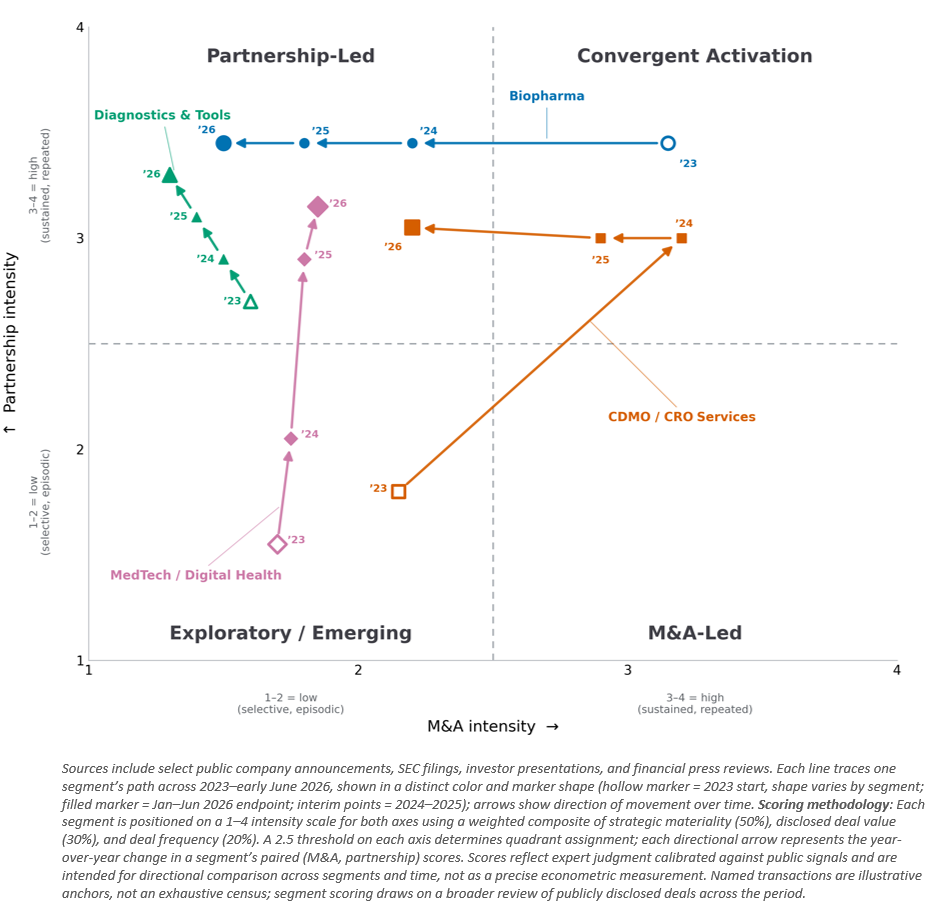
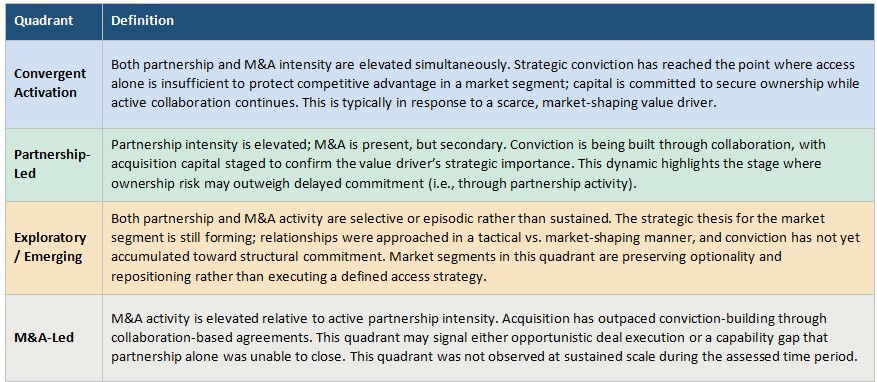
The pattern across the period is best understood as an ebb and flow between partnership and acquisition intensity, rather than a linear shift away from M&A. Partnerships expanded the strategic funnel, and M&A reactivated when market dynamics pointed to access alone as insufficient to protect competitive advantage within a relevant market segment. Figure 1 summarizes this duality by segment and year, showing where collaboration led the market, where ownership converted conviction into capital, and where activity remained exploratory.

Figure 1. Partnership and M&A Strategic Positioning by Segment (2023–Early June 2026)

The Strategic Arc

2023–2024

The period opened with clear differentiation across segments. In 2023, Biopharma stood alone in Convergent Activation as ADC platform M&A activity — Pfizer-Seagen ($43B), Merck-Daiichi ($22B), AbbVie-ImmunoGen ($10.1B) — were executed in tandem with partnerships under acute pipeline pressure. Diagnostics & Tools held in the Partnership-Led quadrant, and both CDMO / CRO and MedTech / Digital Health market segments remained in the Exploratory quadrant. By 2024, the binding constraint shifted from molecules to manufacturing, as the CDMO / CRO segment was propelled into the Convergent Activation quadrant as GLP-1 capacity scarcity triggered simultaneous ownership (Novo-Catalent $16.5B; Lonza-Roche $1.2B) and partnership agreements. In the background, the Biopharma segment displayed Partnership-Led activity, as staged AI and specialty-modality collaboration deals were replacing full acquisitions.

2025–Mid-2026

From 2025 into early 2026, Partnership-Led behavior became the default activity across all four segments. Biopharma’s Greater China licensing surge and mixed-rights mega-collaborations substituted for acquisitions, and Diagnostics deepened evidence and payer-access platforms (Guardant Health; Roche-Foundation Medicine). The MedTech segment crossed into the Partnership-Led quadrant, anchored by Medtronic’s NVIDIA-partnered AI surgical intelligence platform and remote monitoring expansions, and CDMO / CRO services converged back to the Partnership-Led quadrant in early 2026 as key capacity positions were already locked. Biopharma’s mega-collaborations (Pfizer-Innovent $10.5B; Lilly-Haisco $3B; Lilly-Insilico $2.75B) secured global positioning without full acquisitions.

Five Strategic Patterns

A synopsis across the assessed timeframe points to five market patterns that have impacted today’s partnership and M&A activity:

  • Capacity is now a competitive asset.For high-demand modalities, manufacturing access determines launch timing, market-share capture, and asset economics. Executives who treat CDMO and CRO relationships as one-dimensional procurement risk may cede a core competitive advantage within the market.
  • Modality leadership depends on early advantage across the full capability stack.Once a modality demonstrates commercial viability, the window to secure differentiated positioning compresses rapidly. Gaining asset access without platform depth, strategic manufacturing capability, and commercial infrastructure is insufficient to lead a category.
  • AI partnerships have become enterprise architecture decisions.The strategic risk is no longer failing to experiment, but surrendering competitive advantage through data assets, model governance structures, and workflow integrations. Executives should govern AI partnerships by data rights, retention of institutional knowledge, and structural dependency.
  • Diagnostics and tools are becoming the evidence layer of precision medicine.Diagnostics are the primary mechanism by which precision medicines find patients, generate payer-relevant evidence, and create longitudinal data feedback loops. Partnerships in this segment should be evaluated for near-term clinical utility and long-term competitive advantage through data flows, evidence-generation capacity, and adoption pathways.
  • Embedded partners require enterprise governance.As partners become embedded in clinical operations, manufacturing, data workflows, and commercial infrastructure, the classical distinction between vendor and strategic partner starts to blur. Stakeholders should understand whether a relationship shapes an input, a capability, or a future value driver of the enterprise, as each requires a different governance model to ensure near and long-term success.

Altogether, these patterns indicate that the market has moved beyond opportunistic dealmaking into structured strategic positioning.

The Infection Point: 2026-2029

Looking ahead over the next three years (2026–2029), today’s Partnership-Led convergence is best understood as an inflection point. Four dynamics are expected to reshape the ebb-and-flow pattern of partnerships and M&A across the value chain:

  • Biopharma M&A re-acceleration. Early AI platform collaborations will primarily shift to M&A deals as tangible outcomes accumulate in the market. Specifically, in AI data infrastructure, radiopharmaceuticals, and precision companion diagnostics. Expect biopharma companies to typically cycle back toward Convergent Activation activity by 2027-2028.
  • Second CDMO / CRO capacity wave. GLP-1, biologics, and advanced modality demand continues to outpace manufacturing footprints; a second round of capacity-linked acquisitions in cell and gene therapy infrastructure and next-generation fill-finish is likely to occur throughout the late 2020s.
  • MedTech / Digital Health consolidation. AI surgical guidance and care-pathway software partnerships will transition toward selective acquisition as platforms prove clinical outcomes and reimbursement traction, compressing the M&A window for early movers.
  • China licensing overhang. Companies that used Greater China structures to substitute for pipeline investment face a slow-building pressure to replace that exposure through Western-market M&A or accelerated internal development.

The net output of the upcoming years is a partial re-stratification: Biopharma and CDMO / CRO cycling back into Convergent Activation in targeted sub-segments, and Diagnostics & Tools and MedTech / Digital Health segments will likely exhibit Partnership-Led activity as evidence infrastructure matures. For leadership teams, the next 12 to 18 months is the critical window — the period in which today’s partnership positions are established, conversion thresholds are set, and the next wave of selective M&A is being priced and positioned.

Managing Partnerships as a Strategic Portfolio

Life sciences value creation activities has moved materially outside internal company boundaries. Scarce manufacturing capacity, modality expertise, AI data infrastructure, diagnostic evidence platforms, and specialized commercial workflows are now critical value drivers that sit with partners rather than inside sponsor organizations. That shift creates strategic leverage, but also dependency risk. Not all partnerships succeed; evidence-generation failures, integration friction, IP disputes, and shifting strategic priorities lead to termination of partnerships before they deliver value or convert to ownership. The governance framework matters precisely because the cost of failure compounds as partners become embedded within critical operations. For example, a relationship that was once tactical may become costly to unwind when it has reshaped workflows, data infrastructure, or manufacturing dependencies.

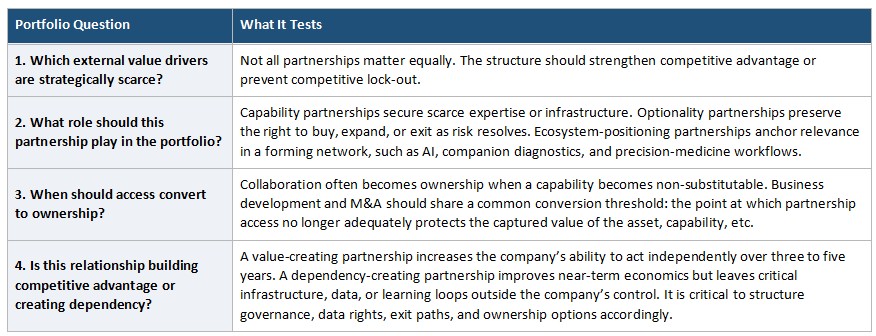
That shift makes partnership strategy a strategic portfolio problem for an enterprise. High-performing companies from 2023 through early June 2026 were making explicit choices about which external value drivers to secure, which relationships to deepen toward M&A, and which dependencies to reduce. Building a disciplined partnership portfolio requires answers to four critical questions:

The strongest partnership strategy will make the thesis explicit: which relationships are essential, which preserve optionality, which should be converted to ownership, and which should be exited or restructured. That thesis requires enterprise-level governance across strategy, BD, M&A, commercial, technical operations, data governance, and finance before market pressure forces a decision.

Conclusion

Decisions about a company’s partnership portfolio require an integrated view across corporate strategy, asset portfolio priorities, operating constraints, commercial access, technical operations, data governance, and transaction design. However, these disciplines rarely converge in a single planning process. The companies that will lead the next cycle are those that build this integration now, before market pressure forces the decision. The most consequential strategic work in the next 12 to 18 months will not be identifying the right partners — it will be deciding which relationships to deepen toward ownership, which dependencies to reduce, and which positions are being competed for without a clear organizational owner. That clarity is the competitive advantage.

References

  •  Associated Press. “Pfizer to Acquire Cancer Drug Maker Seagen for $43 Billion.” Associated Press, March 13, 2023.
  •  Axios. “Pfizer-Seagen Deal: $43 Billion Oncology Acquisition.” Axios, March 13, 2023.
  •  Investopedia. “Merck and Daiichi Sankyo Enter Up-to-$22 Billion ADC Collaboration.” Investopedia, October 20, 2023.
  •  Associated Press. “AbbVie Agrees to Acquire ImmunoGen for $10.1 Billion.” Associated Press, November 2023. Transaction closed February 2024.
  •  Reuters. “Sanofi Partners with OpenAI and Formation Bio to Develop AI-Powered Drug Development Models.” Reuters, May 21, 2024.
  •  Reuters. “Formation Bio Raises $372 Million in Series D with Sanofi Participation.” Reuters, June 26, 2024.
  •  Reuters. “Eli Lilly Expands Insilico Medicine Collaboration in Deal Worth Up to $2.75 Billion.” Reuters, March 30, 2026.
  •  Wall Street Journal. “Bristol Myers Squibb Deploys Anthropic’s Claude AI to More Than 30,000 Employees.” Wall Street Journal, May 20, 2026.
  •  Investor’s Business Daily. “NVIDIA Announces Life Sciences AI Partnerships with Eli Lilly and Thermo Fisher Scientific.” Investor’s Business Daily, January 12, 2026.
  •  MarketWatch. “Novo Nordisk Announces OpenAI Partnership for Drug Development and Enterprise Productivity.” MarketWatch, April 2026.
  •  Reuters. “Novo Holdings Completes $16.5 Billion Acquisition of Catalent.” Reuters, December 18, 2024.
  •  Reuters. “Novo Nordisk to Acquire Three Catalent Fill-Finish Sites for $11 Billion.” Reuters, December 14, 2024.
  •  Wall Street Journal. “Lonza Agrees to Acquire Roche’s Vacaville Biologics Manufacturing Site for $1.2 Billion.” Wall Street Journal, March 20, 2024.
  •  Reuters and BioProcess International. “Samsung Biologics Announces Commercial Manufacturing Agreements with Pfizer.” Reuters, 2023–2024.
  •  Reuters. “Samsung Biologics Acquires GSK U.S. Production Facility for $280 Million.” Reuters, December 22, 2025.
  •  Reuters. “Novartis Agrees to Acquire Mariana Oncology for $1 Billion Upfront and Up to $750 Million in Milestones.” Reuters, May 2, 2024.
  •  Reuters. “Illumina Completes GRAIL Spin-Off After Antitrust Pressure.” Reuters, June 25, 2024. See also: Axios, June 4, 2024; MarketWatch Form 8-K summary, June 24, 2024.
  •  Thermo Fisher Scientific. “Thermo Fisher and Pfizer Partner to Expand NGS Testing Access for Lung and Breast Cancer Patients.” Joint announcement, May 2023.
  •  Thermo Fisher Scientific. “Thermo Fisher and Flagship Pioneering Partner on Life Science Tools Platform Creation.” Joint announcement, November 2023.
  •  Roche / Foundation Medicine. Public company materials and Roche annual reports illustrating Foundation Medicine as an integrated genomic profiling and evidence infrastructure asset. See: roche.com; foundationmedicine.com.
  •  Guardant Health. Annual reports and public filings illustrating the company’s liquid biopsy, residual disease monitoring, and longitudinal oncology data platform strategy. See: guardanthealth.com.
  •  Reuters. “Greater China Life Sciences Licensing Deal Value Reaches $137.7 Billion in 2025.” Reuters, February 13, 2026. Data sourced from PharmCube.
  •  Reuters. “U.S. Drugmakers Sign 14 China Licensing Deals Worth Up to $18.3 Billion in First Half of 2025.” Reuters, June 16, 2025. Data sourced from GlobalData.
  •  Reuters. “AbbVie Agrees to Partner with RemeGen on RC148, Paying $650 Million Upfront with Up to $4.95 Billion in Milestones.” Reuters, January 12, 2026.
  •  Reuters. “Pfizer and Innovent Announce $10.5 Billion Oncology Collaboration Across 12 Programs.” Reuters, May 28, 2026.
  •  Reuters. “Eli Lilly and Haisco Announce Collaboration and Licensing Agreement with Up to $3 Billion in Milestone Potential.” Reuters, June 1, 2026.
  •  Medtronic plc. “Medtronic and NVIDIA Collaborate to Develop AI-Powered Endoscopy and Surgical Intelligence Tools.” Joint announcement, CES, January 2024.
  •  GE HealthCare. “GE HealthCare Expands Cloud-Based AI Imaging Partnerships to Accelerate Clinical Workflow Integration.” GE HealthCare investor materials and press releases, 2023–2025.

About Scimitar

For leadership teams navigating the decisions described in this paper, Scimitar brings an integrated strategy execution lens to biopharma and life sciences. We help executives pressure-test where value drivers are being created, where external dependencies are emerging, and how partnership and M&A structures should be designed to preserve long-term strategic flexibility.

| About The Author


Greg Caldwell’s work spans corporate, portfolio, and pipeline strategy, operational excellence, M&A and asset monetization, new product planning and launch, and enterprise AI strategy and implementation, covering the full arc of value creation across the biopharma enterprise.

He has led pipeline prioritization and governance engagements, supported multi-billion dollar transactions, designed and deployed AI capabilities across R&D and commercial functions, and built the integrated launch and operational frameworks that translate strategy into measurable patient and business outcomes.

Across each domain, his focus remains constant: equipping leadership teams with the strategic clarity, operational rigor, and capability infrastructure required to move faster and more decisively at the moments that matter most.”

greg.caldwell@scimitar.com

Give Us A Call

Our team of experienced life-science consultants collaborate with your team, from strategy development through implementation. By combining experience and innovation, Scimitar works with you to achieve proven results.

Read More

From Dealmaking to Strategic Access: The New Partnership Agenda in Life Sciences

In the rapidly evolving life sciences sector, traditional transactional dealmaking is no longer sufficient to secure a competitive edge. “From Dealmaking to Strategic Access: The New Partnership Agenda in Life Sciences” explores a critical paradigm shift: biopharma organizations are moving beyond isolated mergers, acquisitions, and vendor transactions. Instead, today’s market demands long-term, integrated partnerships focused on global launch excellence, operational sustainability, and real-world value realization. By shifting the objective from mere transactional volume to continuous strategic access—sharing both risks and technical capabilities—organizations can effectively accelerate development pipelines, mitigate operational vulnerabilities, and ultimately deliver life-improving therapies to patients much faster.


Read More »

Strategic Ambition is Not Enough: The Value Realization Imperative for Biopharma

Biopharma strategy is frequently framed around therapeutic-area ambition and scientific leadership, yet these narrative goals alone do not ensure that an organization can convert intent into tangible business outcomes. According to an analysis by Scimitar, industry outperformance belongs not to companies with the most expansive portfolios, but to those possessing a mature “strategic planning system” capable of protecting their value thesis through disciplined resource concentration and proactive capital reallocation. When organizations expand their scope without this institutional governance, they face an accumulation of complexity that accelerates value leakage rather than value creation. Ultimately, true value realization requires shifting from an execution lens that merely tracks completed milestones to a structural framework that sustainably enhances the enterprise’s capacity to deliver measurable economic impact.

Read More »

Launch Excellence and Patient Centricity

To convert your AI ambitions into compounding enterprise value, biopharma leaders must shift from managing a collection of pilots to operating a disciplined portfolio system. This article explores Scimitar’s “AI Value Operating Flywheel,” outlining the structural decisions, governance archetypes, and strategic allocation variables required to ensure AI investments deliver measurable, long-term impact.

Read More »

The Portfolio Imperative: Converting AI Investment into Compounding Enterprise Value

To convert your AI ambitions into compounding enterprise value, biopharma leaders must shift from managing a collection of pilots to operating a disciplined portfolio system. This article explores Scimitar’s “AI Value Operating Flywheel,” outlining the structural decisions, governance archetypes, and strategic allocation variables required to ensure AI investments deliver measurable, long-term impact.

Read More »